A Brief History of Piping in NC — Part II

A Brief History of Piping in NC – Part II

Scottish immigrant Jack Smith formed the Caledonian Pipe Band in Winston-Salem in 1946, NC’s first known pipe band. Smith later formed the Charlotte Caledonian Pipe Band in 1964. Several players from that band helped launch the Charlotte Scottish which became the foundation of the Grandfather Mountain Highlanders. Asheville pipers played in the Charlotte Caledonian band until there were enough bandsmen to form the Asheville Highlanders (now Montreat Scottish). Guilford College and NC State University formed college level bands. High schools in Laurinburg and Statesville fielded bagpipe units to perform with their marching bands. In 1977, the Clan Cameron Pipe Band came together as a competition band, made up of top players who knew each other from two piping schools in the state: the North American Academy of Piping and the Balmoral School. Part II of this brief history follows the formation of community-based pipe bands from the late 1970’s to the present.

Shriners

The Oasis Highlanders (1978) was begun by Paul Webb as a band unit of the Oasis Shrine Temple in Charlotte. The band enjoyed playing for Shrine ceremonies and parades throughout western North Carolina. A highlight was joining with Shrine pipe bands from surrounding states at the South Atlantic Shriner Association. When Bud Cates and Frank Spears heard the pipers in Myrtle Beach, they were inspired to start the Amran Highlanders (1984) in the Raleigh area. A few pipers formed the Sudan Highlanders (1983) based in New Bern and played for Shrine events across Eastern North Carolina. Shrine bands play for the pure fun of it, valuing the fellowship of being in the band. Since non-Shrine pipers could not perform in Shrine events, the McLeod Pipe Band (1985) evolved from the Amran Highlanders as an all-inclusive group.
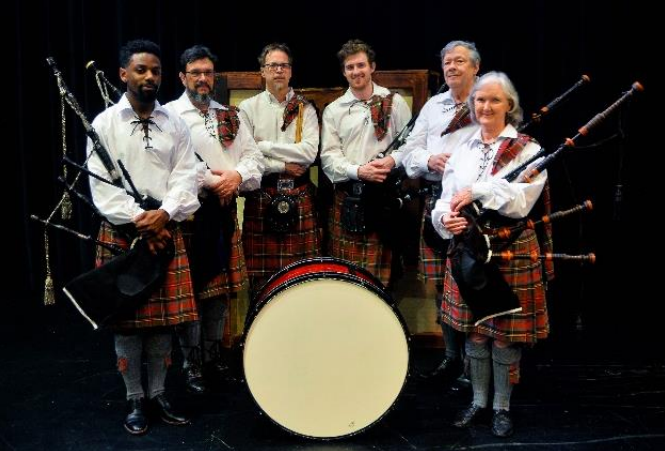
McLeod Pipe Band
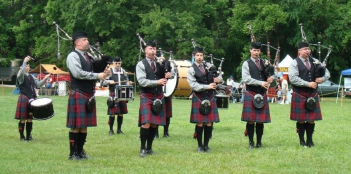
Occoneechee Highlanders

Scout Bands

Gale Buck, a piper in the McLeod Pipe Band, formed the state’s first Boy Scout band, the Occonneechee Highlanders (1990). As youth bands tend to do, players grew up and moved away. The remainder merged with the McLeod Pipe Band and the name changed to the City of Oaks Pipe Band (2000). This band merged with NCSU Pipes and Drums in 2005. Meanwhile in Wilmington, Scoutmaster Darrell Chambers and Kirk Rose started a second Scout band, the Cape Fear Highlanders (1999). As a Venturing Crew troop, it included girls. Each of these scout bands thrived for several years with dedicated leaders and supportive parents.

Scottish Heritage Across the State

Cross Creek Pipes and Drums
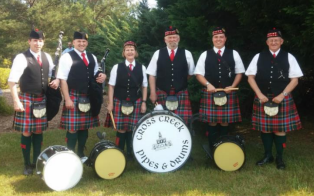
Perhaps most pipe bands come together with the drive of one individual. Knowing that Fayetteville was originally settled by Scots, Bob Palmer felt strongly that the city should have a pipe band. He learned to pipe at the NAAPD, returned home and formed Cross Creek Pipes and Drums (1987). Piper Michael Waters moved to Highlands about the same time that Dr. Gordon Teal, Keeper of Her Majesties Tartans, created a Scottish Tartans Museum in Highlands. Dr. Teal envisioned a pipe band in the area to complement the museum, and

the Highlands Pipe Band was formed (1989). Another confluence of a Scottish museum and a band occurred at St. Andrews Presbyterian College. Piper Bill Caudill was recruited by his alma mater to develop a Scottish Heritage Center on campus as well as form the St. Andrews Presbyterian College Pipe Band (1991). When piper Ed Krintz and his wife Timmy Hord moved to Charlotte, they organized a band to fill the void left by the dissolution of the Charlotte Caledonian Pipe Band in 1990

Highlands Pipe Band
Loch Norman Pipe Band
The Loch Norman Pipe Band made its debut at the inaugural Loch Norman Highland Games in 1996, held at Historic Rural Hill near Huntersville. The same year, Andy Simpson, a former Scots Guards piper, formed the Port City Pipes and Drums in Wilmington, with the band debuting at a Wilmington Burns Supper.

Irish Heritage Too

The first Irish band in the state, Ceol Na Gael Irish Pipe Band (2001) was established in Charlotte by pipers Bruce Thompson and Michael Holian who had recently moved from out of state and met each other at the Ancient Order of Hibernian in Charlotte.

Ceol na Gael Irish Pipe Band
An Gorta Mor
The state’s second Irish band, An Gorta Mor, was started by Dennis O’Brien in Wake Forest in 2020 as a service band for the Wake County Ancient Order of Hibernians. The name is Gaelic for The Great Hunger. The band commemorates the one million Irish that died and the more than two million forced to leave their homes and country to escape the great Irish famine. The band’s mission is to fight hunger.

Branches of the NC Piping Family Tree

Some bands were offshoots of established bands. In 2000, members of the Grandfather Mountain Highlanders living in the Greensboro area formed a Grade V band as a feeder band for the Highlanders. However, the Grade V group quickly developed its own identity and became the Jamestown Pipes and Drums.

Jamestown Pipes and Drums
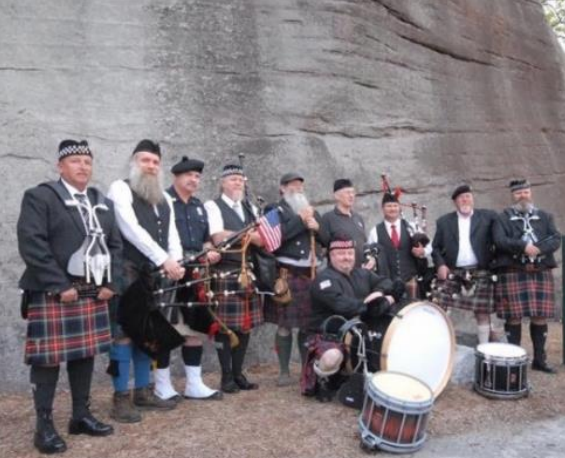
Clan Lindsay Pipe Band
When Jeff Coburn moved away from Durham, he missed playing with the McLeod Pipe Band, so formed the Deep River Pipe Band (2001) in the Archdale community. When that band dissolved, Bob Norris called on a few of its players to form the Triad Highlanders (2010) north of Greensboro while others were available to join Mark
Elliott’s new Clan Lindsay Pipe Band (2010) in the Clemmons area. Darrell Thompson, of the NCSU Pipes and Drums organized the Durham School of the Arts Pipe Band (2007) where he taught. When John Sprague retired as Director of the NCSU Pipes and Drums, he pulled together a few former band members to form a small performance band, Piobadh na Triantan (2014).
Piobadh na Triantan

Pick Up Bands

Chimney Rock Volunteer Pipe Band
Through the years, a few “pick up bands” have gathered annually to play for an event. The Grandfather Mountain Volunteer Pipe Band formed to play at the Grandfather Mountain Highland Games 1965 – 1966. Similarly, the Mint Hill Highlanders (2010) were the host band at the Mint Hill Highland Games near Charlotte. The Chimney Rock Volunteer Pipe Band (2015) plays at Easter Sunrise Services in Chimney Rock State Park. Piping schools, the School of Scottish Arts and the North American Academy of Piping and Drumming, have formed student bands to play for ceremonies during the Grandfather Mountain Highland Games.

Juvenile Pipe Bands

Pipe bands began in NC in 1946 with a youth band. The high school bands and scout bands are no longer active, but each left its impact on piping in NC as many of those same players continue to teach the next generation. A couple of newer bands began with a focus on younger players, but young people grow up, making youth bands challenging to maintain.

The Queen City Juvenile Pipe Band (2014) was begun by Andrea Jones, for youth 18 and under in the Charlotte area. They were successful on the competition circuit for several years. Andrea’s newest undertaking is the Rose and Thistle Ladies’ Pipe Band (2025), a branch of the Queen City Pipe Band. Female pipers and drummers worldwide are coming togetherto compete at the 2026 World Pipe Band Championship in Glasgow, Scotland.


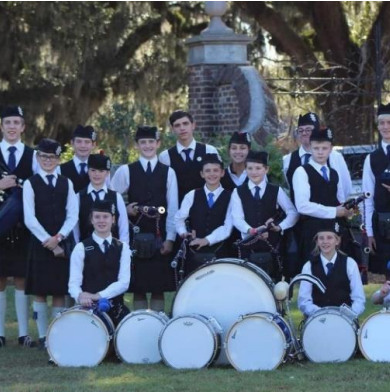
Queen City Juvenile Pipe Band
Clan Lindsay Pipe Band

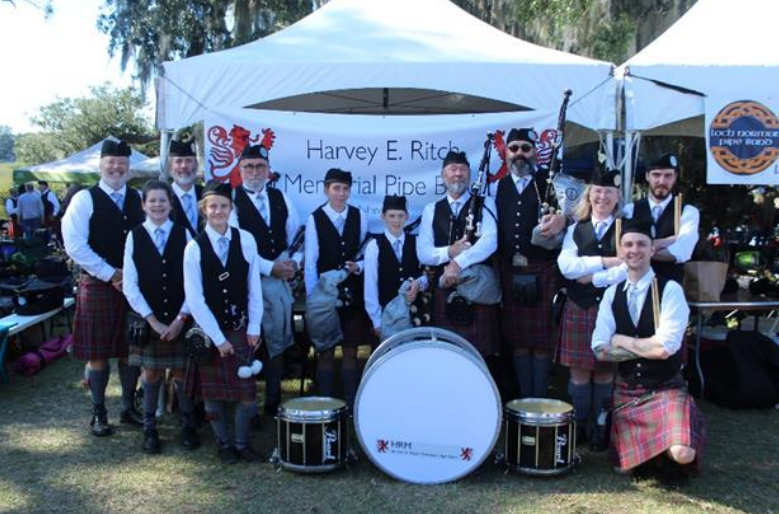
The Harvey E. Ritch Memorial Pipe Band (2019) was created by Gordon and Sally Warburton to continue Harvey Ritch’s lifelong goal of developing young pipers and drummers through quality instruction. The youth did well in competitions

Pipe bands in the state have usually been established by one individual passionate about piping, with both teaching and promotional skills. Bands enjoy their own traditions of performing for Burns Suppers, St. Patrick’s Day Parades, Easter sunrises, and festivals which North Carolina offers. At Highland Games, bands enjoy the awe of playing common tunes with a hundred pipers as one massed band